Michael Grodesky
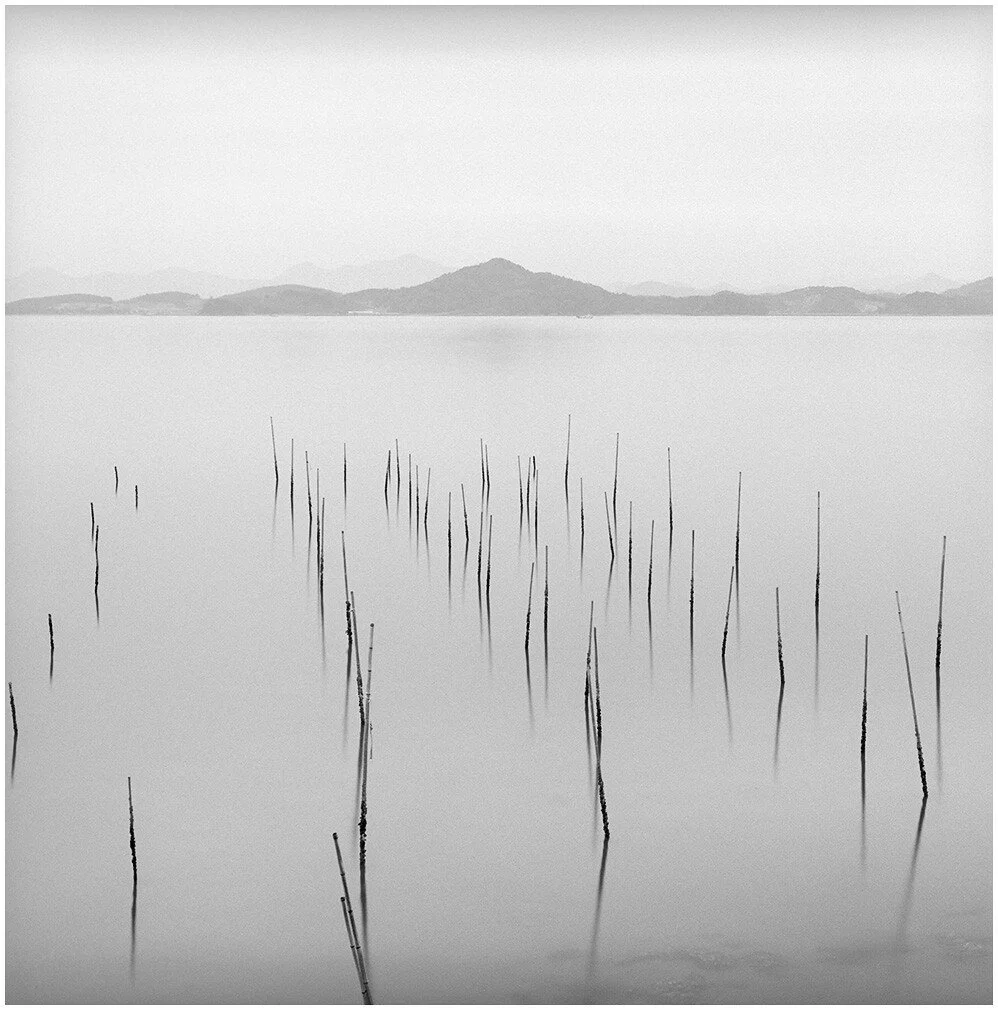
Photograph by Jungwon Park
A photograph. An absence
and a keen presence. A visual pause tenses before the shades of landscape that shadow the distance.
There is breathing space.
I think about absence and presence a lot in my own writing and photography. About the interesting tension between these elements and how often they are associated with a mind-clearing minimalism.
How they resonate together, each making the other more significant.
It was the feeling of presence-enhancing absence that first attracted me to Jungwon Park’s elegant photographs. And while color seems to inhale the elements of an image, Park’s monochrome minimalism exhales an organic calmness. In the scene above, he shows how, with great restraint, the foreground pilings arise from absence.
Yet, they sting with presence.
Years ago my conga teacher, with one eye bent to the latino sound of the clavé, and the other fixed on the value of cultural confluence, handed me a thin book by Japanese composer and writer Toru Takemitsu titled Confronting Silence. “Your textbook,“ he said.
Strange title for a drum class.
Over time I was introduced to Takemitsu’s version of Ma—a Japanese philosophical concept often translated as a spacio-temporal gap or, as my teacher put it, a void that isn’t empty.
Ma gives meaning to form. Form gives presence to emptiness.
I am a minimalist.
I resonate with the idea that minimalism in photography and poetry inherently relies on what is omitted to give weight to what is being expressed. Minimalism aligns with the Ma philosophy of artistic restraint.
And restraint is needed to leave some elements of a frame empty or some portions of a stanza silent.
Photographers and poets often infuse what is sometimes referred to as central tension into their work to give sway over the emotional energy that creates a sense of life in a photograph or a poem. Central tension subtly summons the reader or the viewer to listen more intently. To look more closely.
To feel more deeply.
In Park’s masterfully understated photograph, tension arises as the viewer is drawn to experience those elements that resonate with presence. Here, absence speaks as an invisible reality that, although difficult to describe, is strongly felt.
Writer and musician John Cage suggested that true silence (absence) does not actually exist.
The absence of intentional sound forces the listener to become aware of the presence of unintended environmental sounds. Cage proved this by asking an audience to sit silently for over four minutes as he played not a note, and spoke not a word. During this absence of intentional sound, the background environment became intensely present.
Takemitsu was heavily influenced by Cage, and said so in his writings. They differed somewhat in that Cage viewed silence (absence) in a literal, acoustic sense. Takemitsu saw the tension of absence and presence in an almost spiritual way. He viewed silence as charged space waiting for revelation to occur.
Some readers of poetry seem to fully crystallize the lines of a poem in one or two readings, and to recognize the the devices the poet has used to go beyond subject matter to create feeling and image. For me, however, it takes more time and re-reading to fully grasp what meanings the poet intended.
In most poetry classes I have attended, there inevitably comes a point where the instructor asks someone to read aloud a particular poem, immediately followed by the question: “What is this poem about?“ Usually my first thought is that I have almost no idea.
How much more freeing it would be if instead, the instructor would ask the question that is actually more aligned with poetry: “How does this poem make you feel?”
For me, feelings come almost immediately in a poem or a photograph. Recognizing tension helps. Understanding the meaning comes later.
In this excerpt from George Oppen’s poem Street, one may feel, after the initial reading, the tension of his restraint.
Of his humble rhetoric. Or of his use of absence as the revelation of what is present:
Ah these are the poor,
These are the poor—
Bergen street.
Humiliation,
Hardship. . .
Silence (absence) accentuates the blight and the humiliation. The sparse lineation turns the white space of the page into an active field of tension, rather than just blank paper.
Single words.
An ellipsis.
Like the restraint in Park’s foreground pilings, Oppen’s lines of humiliation and hardship arise from a sense of absence but cry to be present, sustained by the power of what the poet has left unsaid. The ellipsis calls the reader to consider their own completion.
To think beyond the mind’s stream of mental narratives.
Roland Barthes expressed an even deeper paradox. He suggested that a photograph proves the presence of a captured moment in time while simultaneously leveraging its dissolution to an empty space, causing the the viewer to activate imagination.
One might extrapolate this form of Barthes’ paradox to poetry, but in perhaps an opposite way. Consider how the absence (grief and loss) presented in a poem brings the lost person or thing back into existence through language. What is left out intensifies what is included.
Haiku bears the essence of allowing a poem to be minimal, and to let what is left unsaid create powerful feeling. Consider this haiku by classic writer Kobayashi Issa:
my lost mother—
every time I look at the sea,
every time I look. . .
Issa’s haiku uses some of the techniques of Oppen. One might feel the tension of his restraint. The halting dash. The use of space between the second and third line that sets up the ellipsis to compel the reader to see what is so strongly created by the absence.
There is artistic risk here.
A reader or viewer may associate absence with selflessness, mistakenly treating the artist’s aesthetic choice of removal, emptiness, or quiet to be an erasure of self or personal identity.
Conflating the two assumes that a quiet image is a neutral one. Were the choices of what to leave out made by Park, Oppen or Issa just as intentional as deciding what to put in?
Absence is not a lack of self.
The use of absence and presence as an artistic tension is usually carefully curated. When a photographer strips an image to a single horizon line or intense vertical objects in the foreground or
a poet limits an entire line to one word, those absences do not signify the loss of the self. Instead, they amplify the artist’s presence.
One may consider a discussion of the dialectic of absence and presence in poetry and photography to be as abstract or concretely relevant as one wishes.
But who of us in our daily lives is not continually navigating and relating to various absences and presences, consciously or unconsciously, that such concepts would be so completely foreign as to not be appealing when placed before us in an artistic way?
Ancient Chinese poet Lu Chi, in The Art of Writing, placed the tension of absence and presence into the practical terms of a poet’s creative process and mental labor. Rather than treating them as detached metaphysical ideas, Lu Chi framed absence and presence in an interactive way writing:
“We struggle with non-being to force it to yield being. We knock upon silence for an answering music”
We make art to appeal to our sense of humanness. To the here and now.
To bring this experience into view and understand it in human terms.
Whether or not Photographer Park or Poets Issa and Oppen intuitively chose to beautifully emphasize in their respective works the central tension of absence and presence may be unknown.
And who is to say how viewers or readers will respond to this particular elegance of craft. And if the subtle tension of what is absent and what is present will help reveal the soul the artists put into their work.
Either way, these artists move beyond something that is merely descriptive, gently expanding the way we comprehend the world. Gently expanding consciousness.
Gratitudes and Inspirations:
Roland Barthes. The Photographic Message. Originally published in French in 1961, translated by Stephen Heath in Image-Music-Text, (New York: Hill and Wang, 1977).
Ronald Bucknam 1950-2015. My drum teacher. And, my teacher. He continues to inspire me.
John Cage. Silence: Lectures and Writings by John Cage. Wesleyan University Press, 1973. Middletown Connecticut. I learned from my drum teacher that Cage and Takemitsu seemed to share souls.
Kobayashi Issa. The Art of Haiku edited by Stephen Addiss. Shambhala Publications, Boulder, Colorado 2012.
Lu Chi’s Wen Fu:The Art of Writing, translated by Sam Hamill, Milkweed Editions, 2000. Minneapolis. Seattle poet J.T. Stewart turned us on to Lu Chi in my first poetry class at Hugo House in Seattle in 2007. I am thrilled to know that at age 98, Ms. Stewart has released a new collection of poetry. And, happily, I again met Sam Hamill in his beautiful book A Poet’s Work.
George Oppen. Excerpt from Street in New Collected Poems, New Directions, New York 2002. I was drawn to Oppen’s minimalism as depicted in Louise Glück’s essay collection Proofs & Theories.
Jungwon Park. Renowned South Korean-based photographer. He was kind enough to give me permission to use this photograph in the essay. See more of his amazing work at http://jungwonpark.net/?ckattempt=1
Toru Takemitsu. Confronting Silence. Fallen Leaf Press, Berkley, 1995.